


The deep plane facelift has become the dominant technique in facial plastic surgery, and a new study in The Journal of Craniofacial Surgery now documents exactly how widespread that shift has become.
Publication Details
- Journal: The Journal of Craniofacial Surgery
- Authors: Kaitlynne Y. Pak, Parsa P. Salehi, and Babak Azizzadeh, MD
- Publication Date: May 1, 2026 (epub: November 18, 2025)
- DOI: 10.1097/SCS.0000000000012210
Research Objective
The study surveyed 150 AAFPRS members to capture current U.S. facelift technique patterns, complication rates, and how experience shapes surgical choices.
Related: Deep Plane Facelift Beverly Hills
Key Findings
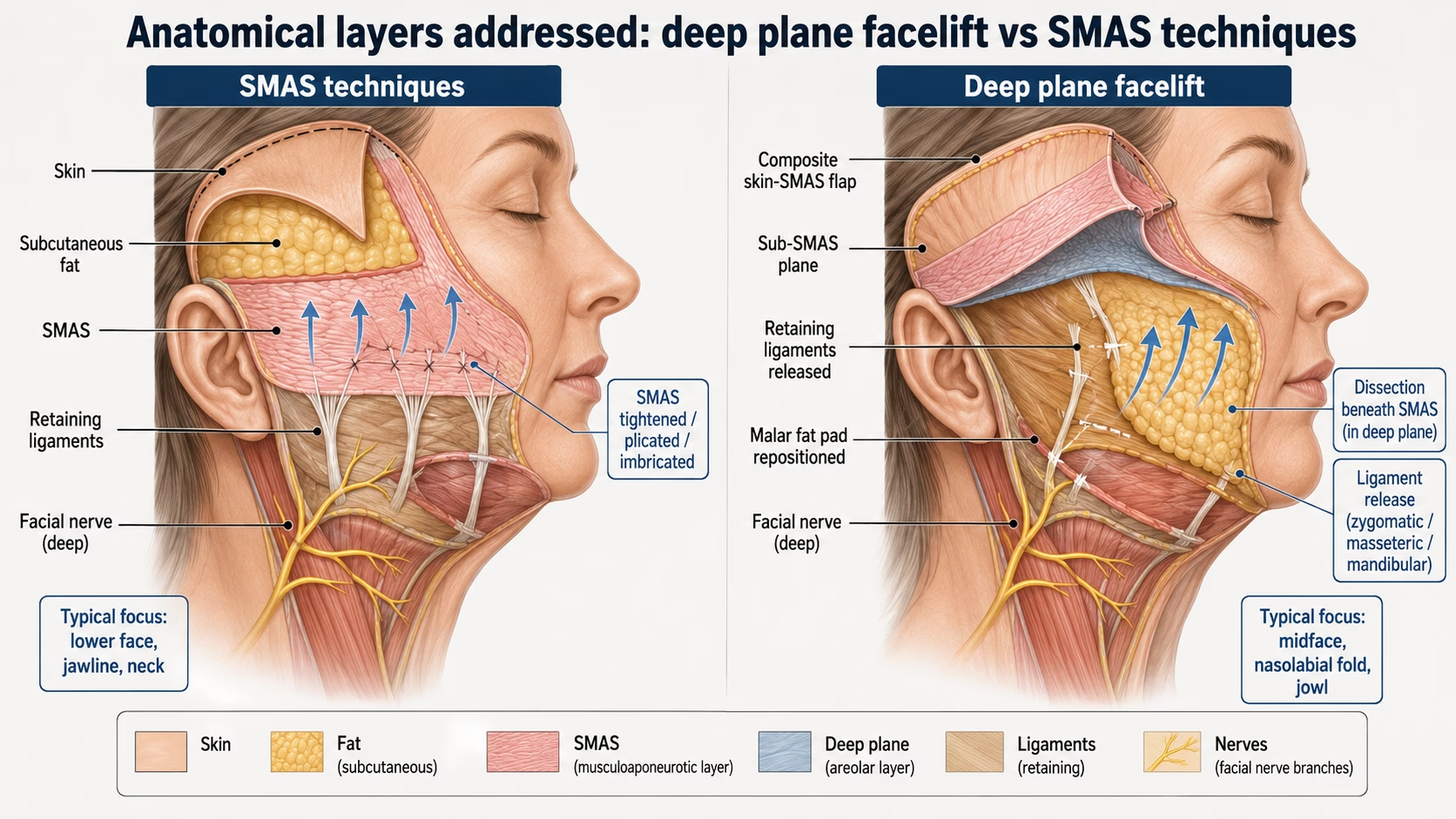
Ninety percent of respondents perform deep plane facelifts. Those favoring other methods most commonly use SMAS application and imbrication. This overview of different types of facelifts covers how these approaches compare.
Surgeons with fewer than 20 years in practice were significantly more likely to use deep plane methods (P=0.04). See deep plane facelift techniques for a detailed breakdown of the procedure.
No significant association was found between deep plane surgery and longer-lasting results (P=0.3), and research on long term outcomes of deep plane facelifts is still evolving.
Transient nerve injuries occurred in 1% to 5% of cases. Higher rates were linked to deep plane surgery and gland reduction. A systematic approach to deep plane facelift surgery emphasizes anatomy as the core risk-management factor.
Patients can schedule a personalized consultation with Dr. Azizzadeh to discuss which approach fits their goals.
 Why This Matters to Patients
This study confirms the deep plane facelift is the most widely used technique among experienced U.S. facial plastic surgeons, which matters when assessing what current best practice looks like.
No single technique suits everyone. Browsing before and after photos of deep plane facelifts from a specific surgeon gives a clearer picture of real results, and surgeon skill ultimately drives outcomes more than technique alone.
Complication rates were low overall. A comparison of deep plane versus SMAS facelifts explains how the two approaches differ in risk profile.
Dr. Babak Azizzadeh is a dual board-certified facial plastic surgeon in Beverly Hills. He co-authored this study with Cedars-Sinai colleagues, specializing in advanced facelifts, facial reanimation, and rhinoplasty.
To speak with a surgeon involved in advancing facelift research, reach out to the Center for Advanced Facial Plastic Surgery.
Related: Deep Plane Facelift Before and After
Read the Full Publication
The complete study, Evaluating Facelift Outcomes and Technique Trends in the United States, is available via the National Library of Medicine. View the full publication on PubMed.
About Dr. Babak Azizzadeh
Dr. Babak Azizzadeh, MD, FACS, founded the CENTER for Advanced Facial Plastic Surgery in Beverly Hills. Recognized by The New York Times, CNN, and Oprah, he holds dual board certification and an international practice grounded in published research.
Frequently Asked Questions
How widely used is the deep plane facelift today?
Ninety percent of 150 surveyed surgeons now perform deep plane facelifts, and younger surgeons are more likely to use this approach, reflecting a shift in training.
Does the deep plane facelift carry more risk than other techniques?
Transient nerve injuries occurred in 1% to 5% of deep plane cases, slightly higher than shallower approaches. These were temporary, and outcomes depend heavily on surgeon skill and anatomy.